Friday, August 5, 2011

USMNT Tactics - Formations - The 4-3-3

This is the last installment in my series covering the basic formations that we could see the USMNT play (for now). The 4-3-3 is very in vogue as an attacking formation, it employs two center backs flanked by fullbacks or outsider backs. The midfield is typically composed of a holding mid who plays behind two centrally located midfielders. On the top of the pitch is a center forward flanked by two wing forwards. In general, the formation looks a little something like this:

The 4-3-3, as stated above, is an attack-minded formation. The basic premise is that the more players you can get up the pitch and into the opponent's attacking third, the more dangerous you become and the more you force your opponent to play defensive and reactive football. It is a proactive system that requires precise passing, great awareness, and a reliance and trust in your teammates.

Defensive Tactics:

Defenders

The role of the back four is first and foremost to defend. Two center backs bear the bulk of the defensive responsibility by accounting for the other teams forwards, tackling hard, snuffing out fires, and playing physical in the air. The two fullbacks contain the other teams wingers or other attackers coming down the flanks. They can also support the center backs by moving inward.

Midfielders

The midfielders are all predominantly central midfielders and clog the center of the pitch to force play to the less dangerous wide positions. Holding mid has a greater defensive responsibility as he is typically located in the area near the opposing team's playmaker and must make life hard for him.

Forwards

Forwards have more defensive responsibility in the 4-3-3 than in either the 4-4-2 or 4-5-1 previously covered. Due to the advent of the attacking wingback, the outside forwards must track back in order to cover the advancing overlapping runs of their counterparts. They have responsibility for the outside portions of the pitch as the three midfielders typically are relied upon to clog the middle of the pitch. The center forward is called upon to pressure the center backs to try to force them into making errant passes or give away possession by playing low percentage long balls up the field.

Offensive Tactics:

Defenders

Because of the large amount of attacking players that are put out onto the pitch in the 4-3-3, it is vital to maintain possession. The center backs must not only be adept and hard-hosed defenders, but also be comfortable with the ball at their feet. Their outlet balls to the midfielders must be spot on and they also act as a pressure relief if things get too clogged in the midfield. The fullbacks are two-way players and their overlapping runs provide width to the attack. Because the three midfielders all occupy space in the center of the pitch, drawing opponents toward the center of the field to try to dispossess them, space on the wings is vacated for the fullbacks to move forward and launch crosses into the box or link with the midfielders and forwards.

Midfielders

The chief offensive role of the midfielders is to keep possession of the ball and link play between the defense and offense. Technical ability is paramount in the midfield. Playing all three midfielders centrally sometimes results in having to work the ball back and forth in tight places. Accuracy and speed of play in offensive touches is at a premium in the 4-3-3. If space does open up, they need to have the awareness to see and attack that space. Each midfeilder, but especially the two attacking mids, must become creative playmakers that can see the field, understand the opposition's formation, and unlock the deficiencies they find.

Forwards

Since three forwards are present, each has a flexibility that is not necessarily afforded to them in a 4-5-1 or 4-4-2. They can drop further into the midfield to collect the ball without ceding valuable space since the other two forwards can continue to stretch the field. Wing forwards can either making darting runs towards goal looking for through balls or runs to the outside of the field, stretching the defense wide to open gaps and looking for balls to the corner to result in a cross or 1-on-1 opportunity from the flanks. The center forward typically plays one of two roles. The first is to play in a "false 9" position, dropping back into the center of midfield to utilize the space between the defense and midfield to collect the ball and distribute to the wings or run at the central defenders. The second is to play as a physical frontman, winning balls, providing holdup play and distributing backwards to the attacking mids, and wreaking havoc with physical play in the box to win crosses provided by the outside fullbacks or wing forwards.

4-3-3 Pros

Attacking with a 4-3-3 can allow you to field as many as 8 attack-minded players in the same lineup and really take the game to the opposition. It creates natural passing triangles that give whomever is possessing the ball a wealth of options going forwarded and multiple options backwards if the forward options are closed down. Additionally, the attack can come from straight up the middle of the pitch through the midfield and to the center forward, inside-outside from the midfielders to attacking fullbacks or wingers, or outside-inside by wingers making diagonal runs. The attack can be creative, varied, and extremely dangerous, allowing exploitation of whatever weakness, tactically or technically, is present in the opposition.

4-3-3 Cons

Success is reliant on controlling possession, and if there are not enough technically gifted or intelligent players to fit into the team, then the results can be dire. Because the formation is so attack-minded, losing possession can result in deadly counterattacks. Moving so many players into attacking positions can leaves holes that can be exploited by a disciplined counterattacking team.

Made famous by:

Originally, Ajax. More recently, Barcelona. The Netherlands side became famous for their 4-3-3 and Total Football concept in the 70s. Johann Cruyff and his cohorts became famous for their attacking and creative play. Today's Barcelona side, arguably the greatest team of all time (and this was written halfway through the 2010-2011 campaign), has reinvented the 4-3-3, with Busquets, Xavi, and Iniesta forming one of the greatest midfields of all time behind consensus the consensus greatest player in the world Lionel Messi who plays in the false 9 position flanked by Pedro and David Villa. Alves and Abidal are model fullbacks who attack with pace, and, especially Alves, play an advanced role at least as often as they play defense. Pique and Puyol are a rare breed of supremely gifted technical players who are very comfortable in possession but also tackle hard and are defensively solid in technique and positioning. They have become the standard by which all other 4-3-3's, and all other teams, are measured.

Thursday, August 4, 2011

Josh Gatt: the future at right wing for the USMNT?

Josh Gatt has been getting a lot of press recently. His manager Ole Gunnar Solskjaer, the former Manchester United player and former manager of Manchester United's reserves, recently advised Sir Alex Ferguson that he should bring in Josh and also U.S.'s Sean Cunningham for a trial at Man U? What does he see in the young right winger? If a picture is worth a thousand words, how much are two videos of Josh Gatt's two goals in his first two games for his new club worth?


Two nutmegs for his first goal and then breaks a defender's ankles for his second. Great to see a young U.S. player who goes at the defense from the wing with speed like this.

Analysis of callups for the Mexico Team

So here is Klinsmann's team:

GK - GK - Howard, Hamid

Howard will get the start, Hamid is an interesting choice, he is only 20, goalie of the future perhaps?

DF-Bocanegra, Castillo, Chandler, Cherundolo, Goodson, Orozco Fiscal, Pearce, Ream

Boca and Dolo are the vets. Great to see Chandler in there, as stated earlier he is the RB of the future. At LB we have Castillo and Pearce. Ream and Goodson will be in the middle. I could see Boca playing the first half and being replaced by Ream in the second. Orozco Fiscal was nowhere near my radar, it will be interesting to see if he sees the field. He should play as a CB, even though he is only 5'11", he is very technically capable.

MF- Beckerman, Bradley, Clark, Edu, Jones, Shea, Torres

This was a bit of a head scratcher for me. Beckerman, Bradley, Clark, Edu, and Jones all occupy the same position on the field. Would have thought at least one of those guys would not be on this roster. Beckerman is probably in the running for best MLS defensive midfielder with Shalrie Joseph. Bradley needs to impress to improve his club situation. I have never forgiven Clark for what he did in the Ghana game...and I never will. Interesting inclusion of Edu, I thought he might get a rest after his match yesterday and with the club season coming up. Jones is German...nuff said. The surprise is the omission of Bedoya and Diskerud and Feilhaber, who would add more flexibility to the lineup than the stable of 5 D mids seen here. My guess (and hope) is we'll see both Diskerud and Bedoya called in for the Belgium friendly since they are European based and in the middle of their seasons. Feilhaber's exclusion does not bode well for his future with the USMNT, this is exactly the sort of game where he should be getting a look if he is in Klinsmann's plans.

I love the inclusion of Shea and Torres. Torres has the technical ability that has been lacking in the middle of the field and Shea could really be a difference maker on the left side.

F- Adu, Agudelo, Beasley, Buddle, Donovan

Five forwards called up? Landon Donovan listed as a forward? DaMarcus Beasley returns from exile? This makes me believe we might actually see the 4-4-2 or even possible a 4-3-3. I speculated yesterday that JK might bring LD in as a forward...just sayin'. Good to see Buddle in there, but he is not going to be an answer going forward for 2014 so I hope the other guys get more of the playing time. Beasley is a surprise to me too, but his speed and technical ability were keys to our run back in 2002. It has been a while since we have seen the same creativity he once had, but I haven't been following him since his fall from grace with BB. Adu and Agudelo are young and technically skilled, no surprise to see their names here, and I hope they get to see plenty of time on the field during the game.

Jurgen Klinsmann presumably laughing at my attempts to understand
what he's trying to do

Overall Impressions:
Not a huge shakeup, although every noteworthy Latin player except Herc Gomez got the call up. Fiscal's inclusion is one I don't think very many people saw coming. The inclusion of 5 forwards seems to suggest that a 4-5-1 is unlikely, especially considering Landon Donovan's inclusion in the list of forwards. I am excited to see if Klinsi will reveal anything about his tactics in the coming days...

Today's Callups

Klinsmann will announce his callups for the Mexico Friendly today, supposedly at 1 pm ET. My guess is that for the friendly, Klinsmann will stick to the 4-5-1. Tactical change usually comes via slow evolution. I know I am going to be way off on these prognostications, but if I were to hazard a guess, this is who I think might be announced today:

GK - Tim Howard, Marcus Hahnemann, Nick Rimando

DF - Gonzalez, Goodson, Bocanegra, Convey, Pearce, Franklin, Ream (EDIT: CHANDLER IS IN ACCORDING TO THIS LINK)

It would be bad form not to have the old captain in there, so Bocanegra still gets the call. Goodson, I have it on good authority (a.k.a. Twitter) got the call and is going. Gonzalez adds the Latin flair Klinsmann seems to indicate he wants and Ream has the technical ability he covets. Gonzo has been injured, though, so he could be replaced by Marshall. Chandler and Dolo are the right backs of the future and present, but they are both in Europe, so expect to see them called up for the friendly against Belgium, but I doubt we'll see them here. Could be wrong though, Chandler is a real possibility. Convey and Pearce fill the LB position (Lichaj has a slight injury), and Franklin is on the right. Demerit is also on the mend or he'd be in here. (Edit: it appears Klinsmann's German sway has already yielded dividends, the link above is to Nuremburg's main newspaper and indicates that he got the callup)

MF - Donovan, Shea, Adu, Bradley, Bedoya, Diskerud, Feilhaber, Torres, Jones

Deuce and Edu are left off the list because of UEFA competitions. Holden just started training with Bolton again. Adu has free time while sorting out his club problems, as does Michael Bradley. Bedoya and Diskerud are in form, Feilhaber, Donovan, and Shea are in the US. Jones cuz he's German :) and Torres because he is in Mexico and I have a hunch that JK likes his game. There is a slight possibility of seeing Beckerman, who is in form and US based, replace Jones or Bradley.

FW - Agudelo, Bunbury, Gomez

Agudelo is the trifecta: Latin, technically skilled, and young. Bunbury and Gomez are local, though you could see Buddle, Wondo or Pontius here too. Could see Davies here too, but I don't think that happens, Pontius has been more valuable to DC than Davies, and Davies really is still getting back from his injury woes. Altidore is getting his feet wet with his new club and needs the practice time with them to make the first team. Klinsi understands that his getting his club career back on the right track is the most important thing right now.

Wednesday, August 3, 2011

The USMNT version of the diamond 4-4-2

So Jurgen (notice no e or umlaut, as requested) will announce his call-ups for the Mexico friendly today (Edit: 1:19 ET ussoccer just tweeted that the roster announcement will be delayed until tomorrow), but until he does that, I'd like to continue my discussion of possible formations. I went on hiatus for a while since the USMNT was also on hiatus, but mostly because things got very busy at work. Until he does unveil his roster, it seemed pertinent to continue my series, especially since Jurgen's formation of choice for much of the 2006 World Cup was the diamond. His appointment and the changes that could come as a result may change a lot of the names here. For instance, this is the version I put together assuming Bob Bradley was the coach:


Now this might be a little bit of a stretch, but it is very easy to see this change into something way different with JK in at coach, something more like this:

As you can see, the only starters between the two formations that would be the same would be Holden in the CAM role, Altidore as one of the strikers (and this is assuming his form picks up at AZ Alkmaar, he could easily be replaced if that doesn't become true), and Donovan on the right (but this could change too, see the discussion below). JK places an emphasis on technical ability, ability to play attacking link-up soccer, youth, and diversity (read: more Latinos). This is the reason Marshall replaces Goodson in the back (We tend to think of Goodson as up-and-coming since he is pretty new to the USMNT starting lineup, but don't forget he is already 29, and he is a grand total of 4 days younger than Gooch), and Gonzalez gets the nod over Bocanegra. Both are more technically gifted, and if Ream can continue to improve he could push for a starting position.

If Timmy Chandler continues his upward trend he seems to be the RB of the future. Lichaj could be a right-footed LB, as he showed very well in the Gold Cup (remember, Klinsi coached Lahm with Die Mannschaft and Bayern Munich, and Lahm is a very adept right-footed LB when employed there), but I get the feeling if Castillo can get playing time he could take over at LB. Same thing for Torres, who seems like exactly the type of player that would fit well in the middle of the pitch, either at the DMF or CAM role. Holden takes the other of those two roles in my proposed starting lineup. Bradley, Jones, Edu, or even Kyle Beckerman could also get a shot at the DMF role.

Outside mid and forward is where things might get interesting. Brek Shea has had a breakthrough season in Dallas, more than making up for the injury to 2010 MLS MVP David Ferreira. If the season ended today, he's have a great case for MVP. His speed from the left wing is scary for defenses, and even though his debut with the USMNT was pretty bad, as long as he keeps his head in the game, his assortment of hairstyles, including the blonde mohawk might become as popular as the Mathis mohawk was circa 2002 (this is not meant to be a curse for his form).

Where JK will put Landon Donovan is probably my favorite question. LD is most dangerous running at people, in the 2002 WC he was a forward and one of the best young players of the tournament. Since then he has played more of a withdrawn role or winger role, but remember that JK brought him on at Bayern Munich as a forward (his four goals in a Bayern kit can be seen here, starting at the 2:43 mark). I think he would be best as a right mid, making incisive runs and creating off of passes from the Holden/Torres duo in the middle, but don't be surprised to see him employed periodically as a withdrawn forward in the "false 9" position. He could even slide over into the CAM slot where I currently have Holden, since Holden may prefer to play as a DMF anyway. This would push Torres to the right or bring in Bedoya or another technically adept midfielder such as Benny Feilhaber.

Up top, our unproven youth in Altidore, Agudelo, and Adu (as well as other young guns such as Corona, Salgado, Wood, etc.) will have to prove themselves to get playing time, but under the tutelage of a former world-class striker, one of these will hopefully breakthrough before the World Cup. Don't forget about Charlie Davies either, he will be in the mix if his form continues to improve. I put Deuce up top because I somehow believe that either he or Donovan will fill the void that exists at the forward position. If two of these other players' development leaps ahead of schedule, that leaves more options since Deuce and Donovan would both be available to fill the midfield ranks.

Going forward, we could see a lineup similar to this, which I would be very excited for for a lot of reasons. Almost every player in this lineup can attack, the midfield is technically gifted enough to possess the ball. Brek Shea on the left and Landon on the right are both adept at running at the defense, something we haven't seen as much of as I would like, and Altidore should get great experience at moving off the ball in the Netherlands, which would transition perfectly to his role in this formation. Both fullbacks have the ability to get forward and overlap on the wings, and the defenders won't just boot the ball upfield and treat possession cheaply. On defense we can clog the middle of the field and force the attack out wide, giving time for our midfielders to cover if the fullbacks get caught up the pitch. The possible weakness of the diamond (lack of technical ability) will be a main focus of JK's tenure, and space in the middle should be opened up on offense as Brek prefers to move outside to make runs off the ball. Overall, it could end up as a vast improvement for offensive football over what we have seen in the past without sacrificing very much defensively.

Wednesday, July 6, 2011

USMNT Tactics - Formations - The Diamond 4-4-2

And we're back in action here at DSF. We lost terribly in the Gold Cup final and I don't want to talk about it. Instead, for now, I will continue my discussion of tactical formations and pretend like all is right in the world.

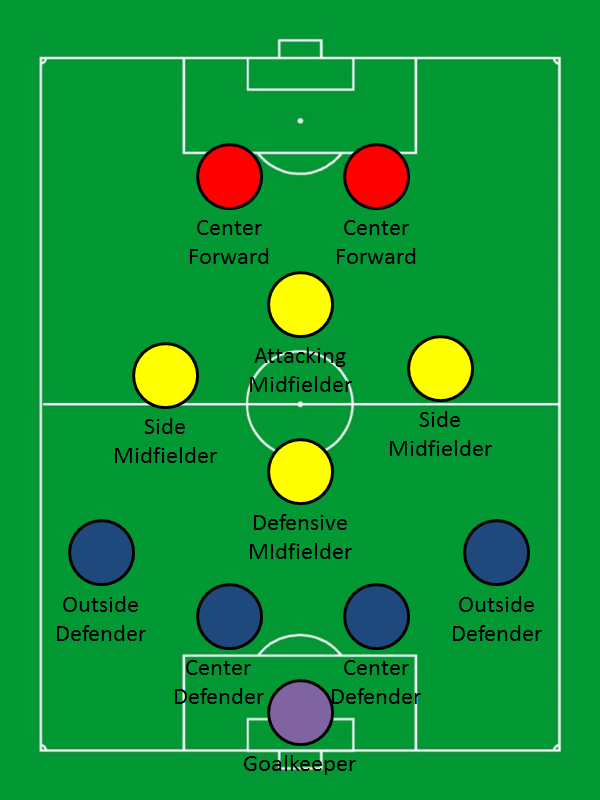
Having covered the standard 4-4-2, the formation most often deployed by Bob Bradley, and the 4-5-1 (a.k.a. the 4-2-3-1), the formation most recently deployed by Bob Bradley, I would like to move on to the formation that I think he should actually deploy. That formation is the diamond 4-4-2 or the 4-1-2-1-2. It looks a little something like this:


Positional Differences from the standard 4-4-2

There are a couple main positional differences between the standard 4-4-2 and the diamond 4-4-2. The most obvious of course is that both center midfielders in a standard 4-4-2 are defensive holding midfielders, whose primary role is to help the defense by tracking back, tackling hard, clogging the middle of the field and closing passing lanes. The diamond 4-4-2 takes one of these central midfielders and pushes them forward into "the hole", the attacking space in between the forwards and midfielders.

One additional key difference is that the two side midfielders are able to pinch into the center of the field. In the standard 4-4-2 the two holding mids play side-by-side, which forces the side midfielders out wide because they occupy the entire central area of the field. Because the two central midfielders in the diamond play on top of each other instead of side-by-side, the side midfielders have more space inside without intruding on the position of the central midfielders.

Defensive Tactics:

Defenders

The role of the back four is first and foremost to defend. Two center backs bear the bulk of the defensive responsibility by accounting for the other teams forwards, tackling hard, snuffing out fires, and playing physical in the air. The two outside backs contain the other teams wingers and can also support the center backs by moving inward.

Midfielders

The one defensive holding midfielder has the same primary role of wreaking havoc to the other teams attack. The side midfielders play box-to-box on their respective sides of the field and have the freedom to move further inside or outside as the flow and tactics of the game dictate. Against teams that like to spread the field wide they have the flexibility to move outside, or against teams that like to work the ball through the middle of the field they can pinch in and further clog the space. The attacking midfielder drops into the space between the defensive midfield and forwards, marking opposing players who are trying to support the attack and applying pressure to the other teams' midfielders.

Forwards

Forwards track defenders or defensive mids pushing forward.

In summary, on defense, the formation looks something like this:


Offensive Tactics:

Defenders:

Center backs have the role to provide service out of the back to the midfield. Outside defenders become critical to the attack in the diamond 4-4-2. Because the side midfielders are pushed more towards the center of the field, they function in an even greater role as wing backs. Most of the width in the attack is provided by overlapping runs down the side of the field by these outside defenders. They become key cogs in the attack and give the attacking team an advantage in numbers going forward.

Midfielders:

The attacking midfielder acts as a playmaker, linking play between defense and offense as well as pressuring the other team when they have possession of the ball. The defensive midfielder can also act as a deep lying playmaker, since there are typically at least 5 players in front of him on offense, his or her distribution and decision making are key to holding possession or launching a quick counterattack. Side midfielders have the versatility to make runs off the ball and distribute the ball forward to the attacking mid, outside backs, and forwards. They give the defenders and defensive mid an option for distribution once the ball is won in defense, and also provide support to the attack.

Forwards

Since the service to the forwards is a combination of interlinked short passes from the attacking midfielder and side midfielders as well as long balls from the defense or defensive mid, they do not have to play solely as holdup strikers, they are free to drop back or make diagonal runs toward goals to give the midfielders options. The additional players supporting them puts less of an emphasis on skilled hold up play since they should have multiple passing options at their disposal to lay the ball off if needed.

On offense, the formation looks something like this:


Diamond 4-4-2 Pros:
Allows for link up play between the defense and offense and maintains possession. Provides a lot of flexibility to play possession or to allow for long balls. Defensively allows flexibility to allow side midfielders to play inside or outside to take away the opponent's strength. Can lead to maintaning a majority of the posession and gives lots of options in both offense and defense.

Diamond 4-4-2 Cons:
Places a large responsibility on the defensive midfielder as an offensive distributor and a defensive stopper. Most of the width in the attack is provided by the outside defenders, potentially leaving the outside of the field vulnerable to counterattacks. Relies heavily on intelligent off-the-ball movement and technical ability to hold possession within the midfield, sometimes in tight spaces because all four midfielders are compressed toward the center of the field.

Made famous by:
Carlo Ancelotti's AC Milan. He had the enviable problem of having too many talented playmakers, so he employed a strategy to get his best XI on the field by employing an attacking midfielder playmaker (initially Rui Costa, later Kaka), and a deep-lying playmaker (Andrea Pirlo). Allowing both room to operate and ply their craft in the middle of the field. His teams won the 2003 champions league, came in second in 2005, and won again in 2007 using the diamond.

Friday, July 1, 2011

Explanation of the lack of posts

I have been out of town all week with very limited time and even more limited internet access. Posting will continue next week