Wednesday, July 6, 2011

USMNT Tactics - Formations - The Diamond 4-4-2

And we're back in action here at DSF. We lost terribly in the Gold Cup final and I don't want to talk about it. Instead, for now, I will continue my discussion of tactical formations and pretend like all is right in the world.

Having covered the standard 4-4-2, the formation most often deployed by Bob Bradley, and the 4-5-1 (a.k.a. the 4-2-3-1), the formation most recently deployed by Bob Bradley, I would like to move on to the formation that I think he should actually deploy. That formation is the diamond 4-4-2 or the 4-1-2-1-2. It looks a little something like this:
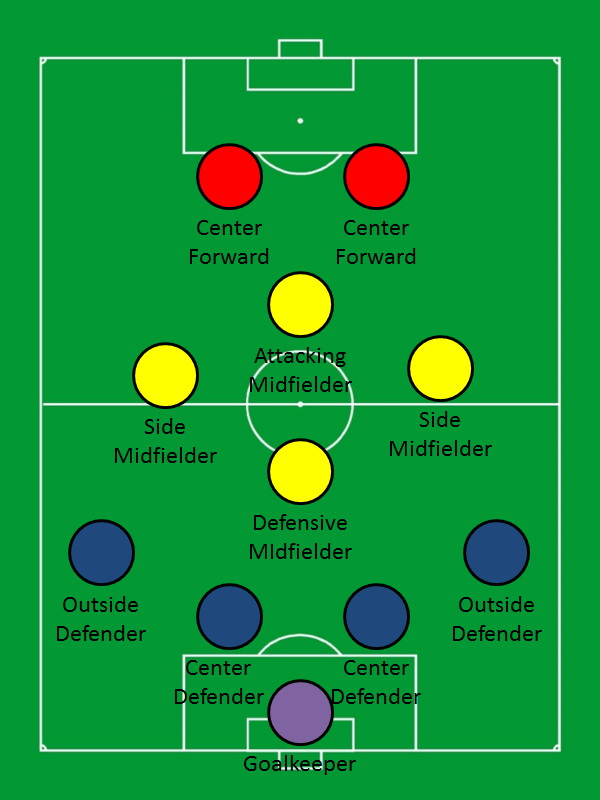

Positional Differences from the standard 4-4-2

There are a couple main positional differences between the standard 4-4-2 and the diamond 4-4-2. The most obvious of course is that both center midfielders in a standard 4-4-2 are defensive holding midfielders, whose primary role is to help the defense by tracking back, tackling hard, clogging the middle of the field and closing passing lanes. The diamond 4-4-2 takes one of these central midfielders and pushes them forward into "the hole", the attacking space in between the forwards and midfielders.

One additional key difference is that the two side midfielders are able to pinch into the center of the field. In the standard 4-4-2 the two holding mids play side-by-side, which forces the side midfielders out wide because they occupy the entire central area of the field. Because the two central midfielders in the diamond play on top of each other instead of side-by-side, the side midfielders have more space inside without intruding on the position of the central midfielders.

Defensive Tactics:

Defenders

The role of the back four is first and foremost to defend. Two center backs bear the bulk of the defensive responsibility by accounting for the other teams forwards, tackling hard, snuffing out fires, and playing physical in the air. The two outside backs contain the other teams wingers and can also support the center backs by moving inward.

Midfielders

The one defensive holding midfielder has the same primary role of wreaking havoc to the other teams attack. The side midfielders play box-to-box on their respective sides of the field and have the freedom to move further inside or outside as the flow and tactics of the game dictate. Against teams that like to spread the field wide they have the flexibility to move outside, or against teams that like to work the ball through the middle of the field they can pinch in and further clog the space. The attacking midfielder drops into the space between the defensive midfield and forwards, marking opposing players who are trying to support the attack and applying pressure to the other teams' midfielders.

Forwards

Forwards track defenders or defensive mids pushing forward.

In summary, on defense, the formation looks something like this:


Offensive Tactics:

Defenders:

Center backs have the role to provide service out of the back to the midfield. Outside defenders become critical to the attack in the diamond 4-4-2. Because the side midfielders are pushed more towards the center of the field, they function in an even greater role as wing backs. Most of the width in the attack is provided by overlapping runs down the side of the field by these outside defenders. They become key cogs in the attack and give the attacking team an advantage in numbers going forward.

Midfielders:

The attacking midfielder acts as a playmaker, linking play between defense and offense as well as pressuring the other team when they have possession of the ball. The defensive midfielder can also act as a deep lying playmaker, since there are typically at least 5 players in front of him on offense, his or her distribution and decision making are key to holding possession or launching a quick counterattack. Side midfielders have the versatility to make runs off the ball and distribute the ball forward to the attacking mid, outside backs, and forwards. They give the defenders and defensive mid an option for distribution once the ball is won in defense, and also provide support to the attack.

Forwards

Since the service to the forwards is a combination of interlinked short passes from the attacking midfielder and side midfielders as well as long balls from the defense or defensive mid, they do not have to play solely as holdup strikers, they are free to drop back or make diagonal runs toward goals to give the midfielders options. The additional players supporting them puts less of an emphasis on skilled hold up play since they should have multiple passing options at their disposal to lay the ball off if needed.

On offense, the formation looks something like this:


Diamond 4-4-2 Pros:
Allows for link up play between the defense and offense and maintains possession. Provides a lot of flexibility to play possession or to allow for long balls. Defensively allows flexibility to allow side midfielders to play inside or outside to take away the opponent's strength. Can lead to maintaning a majority of the posession and gives lots of options in both offense and defense.

Diamond 4-4-2 Cons:
Places a large responsibility on the defensive midfielder as an offensive distributor and a defensive stopper. Most of the width in the attack is provided by the outside defenders, potentially leaving the outside of the field vulnerable to counterattacks. Relies heavily on intelligent off-the-ball movement and technical ability to hold possession within the midfield, sometimes in tight spaces because all four midfielders are compressed toward the center of the field.

Made famous by:
Carlo Ancelotti's AC Milan. He had the enviable problem of having too many talented playmakers, so he employed a strategy to get his best XI on the field by employing an attacking midfielder playmaker (initially Rui Costa, later Kaka), and a deep-lying playmaker (Andrea Pirlo). Allowing both room to operate and ply their craft in the middle of the field. His teams won the 2003 champions league, came in second in 2005, and won again in 2007 using the diamond.

Friday, July 1, 2011

Explanation of the lack of posts

I have been out of town all week with very limited time and even more limited internet access. Posting will continue next week

Friday, June 24, 2011

What to expect against Mexico

The recent success of the 4-5-1 in the quarters and semifinals, along with Jozy Altidore's injury, pretty much ensures that the U.S. will start out in that formation. I expect Kljestan's poor form in the first half, combined with Landon Donovan's overall hatred of all things south of the border (he once said of the rivalry "It's not just another game for me. I clearly, absolutely, desparately want to beat them"), means LD will not start a third straight match on the bench. He'll be motivated and anxious to resume his status as the villian (or the proverbial "man in the black hat" if you are so inclined). He loves and relishes it and has played some of his best soccer against Mexico (2002 WC quaterfinal, and his first international goal came against El Tri).

Point is, Donovan should replace Kljestan, but begs the question of who will play the Central Attacking Midfielder position. Bedoya will probably get the start out wide, leaving Donovan or Dempsey to take the middle. I assume Bradley will push Deuce to the CAM and put Donovan out on the left wing. If it were me, I would switch those roles. Deuce loves cutting inside, and remember that Landon played a withdrawn striker through most of the 2002 WC, when he was extremely effective, and caused Mexico all kinds of problems. I think his distribution is better than Deuce, who often tries to get his first (not necessarily a problem, but maybe not the best fit for the CAM position). If it were me (and it's not), my starting XI would look like this:

--------------------------Howard------------------------
Cherudolo ------- Goodson----Bocanegra-----Lichaj
----------------Jones------------Edu--------------------
Bedoya----------------Donovan-------------Dempsey
-------------------------Agudelo-------------------------

I like Edu over Jones as more of a personal preference. I love Michael Bradley's work rate, and his longball distribution is better than Edu's, but that leads to a propensity to give away possession trying to thread the needle on a long ball when shorter higher percentage passes are there waiting for him. I would have Adu, Bradley and Kljestan on the bench waiting to sub for any of the midfielders.

Bob Bradley, however, will probably trot out these guys:
--------------------------Howard------------------------
Cherudolo ------- Goodson----Bocanegra-----Lichaj
----------------Jones------------Bradley----------------
Bedoya----------------Dempsey-------------Donovan
-------------------------Agudelo-------------------------

If we have the game in hand, look for him to bring on Edu and Kljestan as subs for Bedoya and Donovan. Adu could see action if the offense is stagnant or we are behind and need some creativity off the bench. The match probably hinges for the U.S. on two things. First, they have to maintain enough possession to keep the ball out of their own end as described in my previous post about the drawback of the 4-5-1. Second, they HAVE to finish their chances, because they certainly won't be as plentiful as they were against Jamaica or Guadeloupe. Look for both teams to come out trying to draw first blood. The U.S. has to be disciplined against Chicharito and Lichaj and Dolo can contain the opposing midfielders and marauding runs of Giovanni Dos Santos. Mexico probably has the superior talent, but the U.S. can pull this out if they stay disciplined and are sharp on the ball.

Thursday, June 23, 2011

Is Bob Bradley smart, stupid, or lucky?

I thought I knew who Bob Bradley was, but last night he threw me a couple of curveballs, one especially that I didn't expect. Bob Bradley has been described as many things, but unpredictable has never been one of them. Watching a U.S. soccer game is usually like watching a Rocky movie, you know the plot and main characters going in, you know Rocky will at some point get a beatdown and you know he's going to train, punch some meat and then win the fight at the end of the movie (I haven't seen Rocky Balboa, so if that one isn't quite as formulaic then I apoligize).

For the last 5 years we have been treated to almost identical team selections and lineups, regardless of form or the abilities of the starting XI. His teams sit back, play defensively, and he hopes Howard pulls out a couple of world class saves and leans on Donovan or Dempsey to provide a moment of brilliance to get the W. Then came last night's games. Here were the surprises to me, in order of least surprising to most surprising: we continued with the 4-5-1 (not very surprising), Bedoya got the start (mildly surprising given his form), Kljestan got the start (surprising only because of the man he replaced), that when Kljestan was playing poorly he got subbed out at half and didn't get another chance (Bob doesn't usually make halftime subs in big games, preferring to wait til the 60 minute mark or later), Donovan wasn't in the starting lineup (when I saw this I was shocked), and Freddy Adu coming on as a sub without a significant injury having occurred and while the result was very much in doubt (I could not believe my eyes when this happened, it was completely unexpected and made me question everything I knew to be true).

Sure, he stayed true to form in that Howard came up with a couple big saves and it took a moment of brilliance from D&D to get our only goal, but vanilla Bob busted out a little neopolitan last night. The first four things on that list could be explained away as an "if it ain't broke don't fix it" move. The same exact starting XI came out for the Panama game as the Jamaica game. That was a big risk. If we lose this game, everybody is second-guessing him for leaving Landon out of the starting lineup. As a country we have rode Landon Donovan to greatness since the 2002 World Cup. Bob Bradley has gone to battle with LD in his starting XI almost every match since taking over as manager. LD is the all-time leading scorer in USMNT history and has been as dangerous as anyone in the MLS this season. He is the face of the team, he scored the Algeria goal that sent America into euphoria just one year ago. To take this player, who as far as we can tell isn't injured, and tell him to sit on the bench and watch the first half from there surprised everyone, I'm sure even Kljestan, Bedoya, and Landon.

Bob doesn't seem to like change much, but in this case not making a change was in and of itself a really big aberration from what we normally see. But then when Kljestan, seemingly one of Bob's favorites, was a little off in the first half, Bob didn't hesitate. He put Donovan in. I guess it helps to have somebody of Donovan's quality to be able to do that, but still, making a change that early is something we don't often see from Bob except in friendlies. But then when Adu came on for Agudelo I think everyone was shocked. Bob has repeatedly said that he brought Adu in to see how his development is going and how much he has progressed. Adu was left off the 18-man roster for the first two group stage games. He was as far from the field as you could be and still be on the 23-man roster. And yet, there he was at the 64th minute, standing at the half line waiting to come in.

What inspired this change? I'll never know. If Bob wanted to be ultra-conservative as it seemed he was trying to be by sticking with the exact same lineup then how can we explain this decision. Did he actually decide mid-game to change his tactics? Does he actually watch the game from the sideline? I could never tell from that unfocused stare if he was interested in what was going on on the pitch or just considering how cool he looked in his awesome track warmups. But for one night, Bob did what I thought he'd never do. He broke from his normal plan, he made bold moves. And the craziest part is they all worked out perfectly. The lone goal was created on a sweet through ball by Adu (a substitute) to Landon Donovan (a substitute), who put the ball on a rope through one defender's legs to the past two more to Dempsey, who only had to stick out a leg to get it in the back of the net. Deuce understood how great of a ball that was, and I bet if you asked him he would say Donovan deserves credit for the goal more than he does. Have you ever seen the goal scorer defer like that during the celebration to the guy who made the assist? I never have.

I still don't know what to think. For the first time in a while I have hope that this team can progress. Bob really went out on a limb last night. He made unpopular decisions that could get him fired if they turned out wrong because it seems that he felt like they were the best thing he could do. What's more, those changes make sense based on recent performances and form and resulted in a win. I don't often agree with what he does, but in answering my own question. I think last night, Bob got a little lucky, but created some of that luck by being smart. That's two games in a row that I have been impressed with his tactics. I don't think that's ever happened before. It gives me hope. Now let's see if he can do against Mexico.

Wednesday, June 22, 2011

The main drawback of the 4-5-1

Thus far most of my analysis of the 4-5-1 has been positive. This is probably because the result against Jamaica was so positive. However, every formation has its strengths and weaknesses, and the weakness of the 4-5-1 is that it depends on you keeping possession for it to work properly. Against a technically gifted side (like Spain, just as a random example that has nothing to do with recent friendlies or pitiful results) that is able to cause turnovers and rarely gives up possession, the 4-5-1 produces the exact opposite results as it did against Jamaica.

If you are constantly under pressure from the opposing team and unable to build possession, you are fighting a losing battle. The four defenders and five midfielders effectively form a shell around the penalty box, leaving the striker on an island as the only attacking player. If the other team maintains possession and pressure, once you win the ball you are forced to quickly release it, but there is nobody there to link the play to the forwards, so the only option is to clear the ball. Since your striker can only be at one place at one time, the majority of these clearances wind up being won by the opposing teams defenders, who reset possession and repeat the process again. At that point you are essentially playing not to lose, which in my book is worse than losing itself.

I don't think Panama has the quality to be able to pose this kind of problem tonight, but going forward this is something I will be following closely. Can the U.S. cultivate the type of skills and movement required to possess the ball against more technical sides? If we want to take the next step, and if that step is going to come under the 4-5-1, that will probably be the key.

UPDATE: Apparently Bob Bradley agrees with me, some of his comments on the 4-5-1 courtesy of ESPN:
"In an ideal world, when you get good movement, the forward is not alone that often," said Bradley. "But there are still ways [in which] other people are moving quickly when necessary to join in and be available so that you aren't just leaving him stranded. One of the things that becomes key to make that happen is you need to be able to move the ball well. If it's a day when you're under pressure, and you've got a lot of guys back, and now when you get the ball you're pressed right away and all you can do is play it up to the forward, he's going to feel like he's on his own. But if it's a day where as a team, you're good with the ball, then there are times when it doesn't really look like one forward."
I guess we agree on one thing at least :)

Altidore is out the rest of the GC

You can see the article at ussoccer.com here:
http://www.ussoccer.com/News/Mens-National-Team/2011/06/Altidore-Sidelined-46-Weeks-After-Hamstring-Injury.aspx

4-5-1 vs 4-4-2 Movement off the ball

I watched the Jamaica game again last night, and want to explain one aspect of the 4-5-1 that I think really helped us with possession. Let’s throw up the graphic of the base formation again shall we?


One of the reasons this worked so well is because we finally were moving off the ball. One of my chief criticisms of the U.S. attack of late is the lack of movement and runs into space to allow for positive buildup towards the attacking third. The U.S. typically filters possession through their holding midfielders Bradley and Jones. In the more structured 4-4-2, as one pushes forward with the ball, the other will drop off to be sure to maintain defensive shape (in this example Jones has the ball and Bradley drops).


This leaves the only options a longer ball to one of the forwards, a long ball to the other side of the field, a short ball to the near side winger, or to turn and drop it to the fullbacks or other holding mid. If they drop the ball, it usually ends up switching sides and filtering back to the holding mids who once again have the same options.


The only 3 attacking options are 2 long balls or a short pass the winger who is then pinned in a similar position without many options going forward. Many people wonder how the U.S. has become so reliant on the long ball, the formation, tactics, and philosophy presented here are the main culprit. Additionally, this leads to stagnation and little off the ball movement. Nobody is in a position to make an incisive run except the other holding mid, but he is duty bound to stay back because vacating the defensive space in front of the center backs is of higher priority than making an attacking run.

Let’s look at the same scenario in the 4-5-1. U.S. wins the ball and it is played to Jones who turns and starts upfield and sees a completely different field in front of him.


The 4-5-1 promotes movement off the ball because it creates natural passing triangles in the midfield and because the extra midfield players are close enough to cover for each other if they make attacking runs. If Dempsey wants to make a run inside, Kljestan has the flexibility to push wide to fill the space he just vacated. Similarly, should Bradley decide to make a through run up the middle of the pitch, Kljestan can simply step a few feet back. The defensive mid who was covering Kljestan is forced to pick up Bradley because his movement toward goal is the greatest threat. This opens up space for Kljestan as he steps a few feet back. If they leave Bradley uncovered, Jones can play a through ball and he is in on the defense. If they cover Bradley, Jones can lay the ball off to Kljestan, who now has space in front of him to advance the ball. If the outside midfielder pushes inside to overload, Donovan can step outside. Jones now has as many short pass attacking options (3) as he had total attacking options in the 4-4-2, and he still has the long ball to the forward or Dempsey as an option. Here’s a diagram of this scenario:


What it boils down to is that the holding mid has more options for short passes that maintain possession than he does in the 4-4-2. Additionally, the pressure relief is a neutral pass in the 4-5-1 (the Kljestan square ball) as opposed to a negative pass in the 4-4-2 (to the withdrawn holding mid or defense). When the majority of the play goes through the holding mid, this multiplicity of options allows for possession and buildup play to occur, and creates a more consistent offense.